The number of companies building automation agents and intelligent workflow tools has grown rapidly in the last two years. However, building a capable product is only one part of the equation. The real challenge for startups is bringing that product to market in a way that clearly communicates its value and attracts early customers.
Research shows that most product launches fail not because of weak technology but because of poor market alignment. According to an analysis cited by CB Insights, 42% of startups fail due to lack of market need, which often reflects weak product positioning and an unclear go-to-market strategy.
At the same time, enterprise adoption of automation technologies continues to accelerate. A survey by McKinsey & Company reports that 65% of organizations now use AI in at least one business function, reflecting the rapid shift toward automation and digital workflows across industries.
For founders building AI agents, this combination of high demand and high failure rates creates a clear reality: technology alone does not drive adoption. Market strategy does.
A well-structured go-to-market strategy helps a startup define:
-
the exact customer problem it solves
-
the industries where adoption will happen fastest
-
the messaging that differentiates the product
-
the distribution channels that bring early users
This guide explains how founders can build a practical go-to-market strategy for an AI agent startup, covering customer selection, early adoption strategies, developer ecosystem growth, and product-led expansion.
Why AI Agent Startups Need a Structured GTM Strategy
Startups building AI agents often assume the product’s capabilities will naturally attract users. In reality, buyers adopt solutions when they clearly understand the operational value.
In many industries, automation tools compete with:
-
manual processes
-
internal tools built by engineering teams
-
traditional SaaS platforms
Without a focused go-to-market strategy, the product risks becoming difficult to position in the market.
A GTM strategy ensures alignment across three critical areas:
Market problem – the operational challenge the product solves
Customer segment – the organizations most likely to adopt the solution
Distribution channel – the path through which customers discover the product
For AI agent startups, these three factors determine whether the product reaches early traction or remains in experimentation.
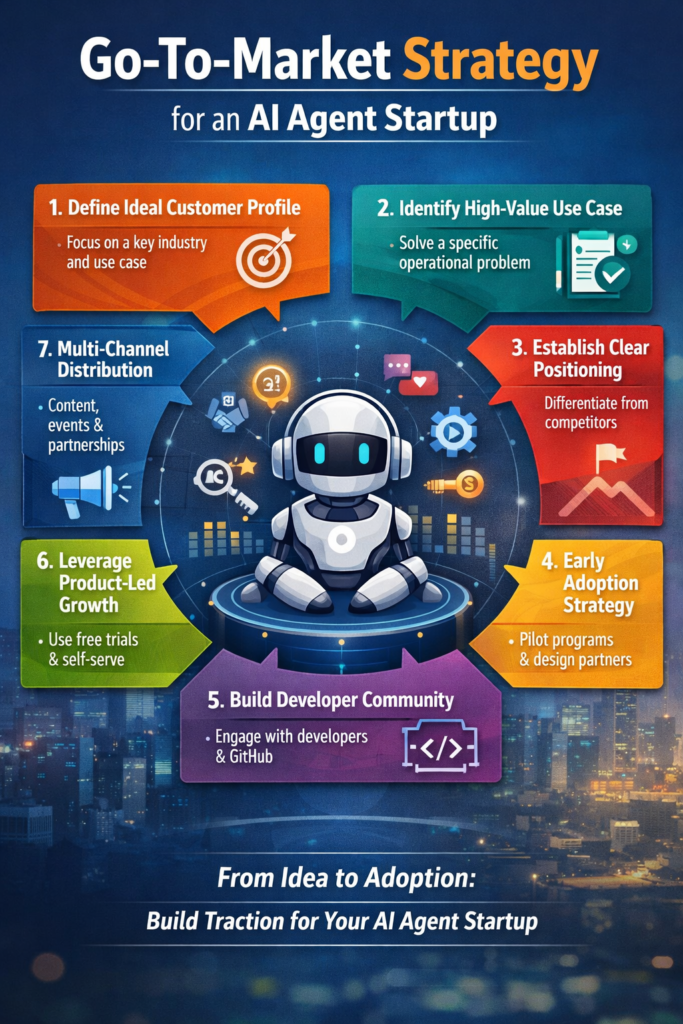
Step 1: Define the Ideal Customer Profile (ICP)
The first step in any GTM strategy is identifying the organizations most likely to benefit from the product.
Many startups attempt to serve multiple industries simultaneously. This approach usually weakens positioning and slows adoption.
Instead, early-stage companies should identify a focused Ideal Customer Profile (ICP).
A strong ICP definition includes:
Industry
Example: financial services, logistics, healthcare operations
Company size
Example: mid-market companies with large operational teams
Primary use case
Example: document processing, customer support automation, or workflow orchestration
Technology maturity
Organizations already investing in automation tools adopt new solutions faster.
For example, an AI agent designed to automate compliance document review may initially target regulated industries such as healthcare or financial services, where manual workflows are expensive and time-consuming.
Clear ICP selection improves marketing efficiency and shortens the sales cycle.
Step 2: Identify a High-Value Use Case
AI agents often support multiple workflows, but early adoption usually happens around one strong use case.
Examples include:
-
customer support automation
-
document processing
-
research and knowledge retrieval
-
compliance monitoring
-
workflow orchestration
Rather than promoting a broad “automation platform,” startups should position the product around a specific operational outcome.
For example:
Instead of saying
“An AI agent for business operations”
A stronger positioning would be
“An AI agent that automates compliance document review for financial institutions.”
Clear use-case positioning makes it easier for buyers to understand the product’s value.
Step 3: Create Clear Product Positioning
Product positioning determines how the market understands your solution compared with alternatives.
For AI agent startups, the most effective positioning usually focuses on one of three categories:
1. Workflow automation – Replacing repetitive operational tasks.
2. Operational intelligence – Supporting research, analysis, and decision-making.
3. Developer infrastructure – Providing APIs or platforms to build automation systems.
The positioning statement should clearly answer three questions:
-
What operational problem does the product solve?
-
Who benefits most from the solution?
-
Why is it better than existing alternatives?
Clear positioning improves both marketing effectiveness and sales conversion.
Step 4: Design an Early Adoption Strategy
Early traction is critical for validating a startup’s product and refining its messaging.
Most AI agent startups gain early adoption through one of the following paths.
Industry-specific pilot programs
Target organizations with clear operational inefficiencies and run small pilot deployments.
Pilot programs allow startups to:
-
validate the product in real environments
-
gather feedback from real users
-
generate early case studies
Founder-led sales
Many successful SaaS companies initially rely on direct founder involvement in sales conversations.
This helps the product team learn:
-
how buyers describe their problems
-
which features deliver real value
-
what objections appear during purchasing decisions
Strategic design partners
Design partners are early customers who collaborate with the startup to refine the product.
In exchange for early access, they provide:
-
operational feedback
-
workflow insights
-
public case studies
Design partners often become the first reference customers.
Step 5: Build a Developer Community Around the Product
Many successful AI products expand through developer ecosystems. Developers often influence technology adoption within organizations, especially when tools integrate into existing systems.
A developer-focused strategy may include:
Open APIs – Allow developers to integrate the agent into internal tools.
SDKs and documentation – Provide clear technical documentation for quick adoption.
GitHub repositories – Demonstrate sample integrations and real use cases.
Technical tutorials – Show developers how the product solves specific automation challenges.
Developer communities often become powerful distribution channels, especially for infrastructure or automation tools.
Step 6: Use Product-Led Growth to Drive Adoption
Product-led growth (PLG) allows users to experience the product before committing to a purchase. This model is particularly effective for software products where value can be demonstrated quickly.
Common PLG mechanisms include:
Free usage tiers- Allow users to test automation workflows.
Usage-based pricing – Charge based on activity or automation volume.
Self-service onboarding – Enable users to deploy the product without sales interaction.
When users experience immediate productivity improvements, adoption spreads within organizations.
Step 7: Choose the Right Distribution Channels
The distribution strategy determines how potential customers discover the product.
For AI agent startups, several channels consistently drive early traction.
Content and SEO – Publishing educational content about automation challenges can attract operational leaders searching for solutions.
LinkedIn thought leadership – Many enterprise technology buyers actively engage with professional content on LinkedIn.
Developer communities – Platforms such as GitHub, technical forums, and developer newsletters can accelerate product awareness.
Industry events – Operational leaders often evaluate automation solutions during industry conferences and webinars.
A diversified distribution strategy ensures consistent pipeline growth.
Common GTM Mistakes AI Agent Startups Should Avoid
Even strong products struggle when go-to-market execution lacks focus.
Common mistakes include:
– Targeting too many industries simultaneously
– Weak product positioning
– Overemphasis on technology instead of business outcomes
– Lack of early customer validation
– Limited distribution channels
Startups that focus on one customer segment and one clear use case typically achieve faster adoption.
Final Thoughts
The market for AI-driven automation is expanding rapidly, but success depends on more than technological innovation. A clear go-to-market strategy helps startups translate product capabilities into real customer value.
Founders who define their ideal customer profile, position the product around a specific operational problem, and build strong early adoption channels are far more likely to gain traction.
As automation adoption increases across industries, startups that combine strong technology with disciplined market strategy will be best positioned to build sustainable growth.
FAQ Section
What is a go-to-market strategy for an AI agent startup?
A go-to-market strategy defines how a startup introduces its AI agent product to customers, including target market selection, product positioning, distribution channels, and customer acquisition strategy.
Why do AI startup products fail after launch?
Many startups fail due to weak product-market fit or unclear positioning. Research shows that about 42% of startup failures occur because the product does not solve a clear market need.
What industries adopt AI agents fastest?
Technology, media, telecommunications, and knowledge-intensive sectors are among the industries with the highest adoption of AI-driven automation tools.

vetrivel is an accomplished SEO and digital marketing expert with 5 plus years of experience. dedicated to providing readers with informative and engaging content.