Search has entered a new operating model. In 2026, B2B buyers no longer move linearly from query to website to conversion. Instead, they interact with AI-powered search experiences that summarize information, explain concepts, and surface recommendations instantly. These answers often appear before any traditional organic result, shaping perception and decision-making long before a click happens.
For B2B SaaS brands, this shift introduces a new challenge. Ranking well is no longer enough. If your content is not structured to be selected, interpreted, and cited by AI-driven systems, your visibility will not translate into influence. This is where Answer Engine Optimization, or AEO, becomes a strategic requirement rather than a tactical experiment.
This article explains AEO from a practical, industry-aligned perspective. It focuses on how AI-powered search selects content, how B2B SaaS teams should structure their pages to meet those expectations, and how to measure success in a landscape where clicks are no longer the primary signal of impact.
Why Search Is No Longer About Rankings Alone
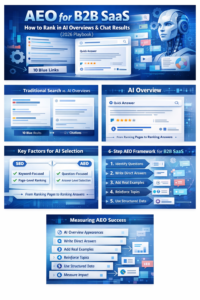
For years, SEO strategy was built on a simple assumption: higher rankings lead to more clicks, and more clicks lead to business outcomes. That assumption is no longer reliable. AI-led search experiences are designed to resolve intent immediately. When buyers ask questions about software capabilities, use cases, or comparisons, they increasingly receive complete answers directly within the search interface. These answers explain how a solution works, outline differences between tools, and provide contextual guidance without requiring users to visit multiple websites.
This behavior is particularly pronounced in B2B SaaS, where buyers are cautious, research-driven, and focused on reducing risk. They are not browsing for inspiration; they are validating options. If your content does not appear in these AI-generated explanations, your brand is effectively removed from early-stage consideration, even if your site ranks well organically.
What Answer Engine Optimization Really Means
Answer Engine Optimization is the discipline of structuring content so that AI-driven search systems can clearly extract meaning, evaluate trustworthiness, and present that content as a direct answer to a user’s question.
Unlike traditional SEO, which optimizes entire pages for keywords, AEO focuses on individual answers within a page. AI systems do not need a comprehensive article to select content. They need a precise, self-contained explanation that directly addresses a specific query. The goal of AEO is not to drive a click at all costs, but to ensure that when an answer is generated, your content is the source behind it. For B2B SaaS companies, AEO complements SEO rather than replacing it. SEO ensures discoverability, while AEO ensures authority and influence within AI-mediated experiences.
Why AEO Is Especially Critical for B2B SaaS
B2B SaaS buyers behave differently from consumer audiences. Their searches are more detailed, more technical, and more intentional. They want to understand how a product works, how it compares to alternatives, and whether it fits their regulatory, security, or operational requirements.
AI-generated answers now sit above all these moments of intent. They define categories, explain terminology, and provide context for comparisons. When your content is cited in these answers, it establishes early trust and positions your brand as a credible authority. When it is absent, competitors define the narrative instead.
In long sales cycles, this early influence compounds. Buyers who encounter your brand repeatedly in AI-led explanations arrive at sales conversations better informed and more confident. AEO, therefore, plays a direct role in pipeline quality, not just top-of-funnel visibility.
How AI Overviews and Chat-Based Search Select Content
Although AI models continue to evolve, content selection patterns have become increasingly consistent, particularly across systems influenced by Google. AI-powered search favors content that aligns closely with the user’s question and delivers a clear, concise answer that can stand on its own. Sections that explicitly state the question and immediately provide a direct response are far more likely to be selected than long, narrative introductions.
Another critical factor is demonstrated experience. AI systems are designed to minimize risk when presenting information, which means they prefer content grounded in real-world usage, implementation insight, or observable outcomes. Generic explanations, even when accurate, are less likely to be surfaced than content that reflects practical knowledge.
Ultimately, AI systems evaluate content within its context. Pages supported by related articles, product documentation, and consistent internal linking are more trustworthy than isolated posts. Clean formatting, logical headings, and structured data further reduce ambiguity, making it easier for systems to interpret intent.
A Practical AEO Framework for B2B SaaS Teams
An effective AEO strategy begins with identifying the right questions. These are not broad keywords, but specific queries that require explanation or evaluation. In B2B SaaS, they often emerge from sales conversations, onboarding friction points, customer support interactions, and high-impression search queries with low click-through rates.
Once the question is identified, the content must be structured so the answer appears immediately. The first paragraph under each question should deliver a complete explanation in clear, direct language. Additional context, examples, or details should follow only after the core answer is established. This approach improves both AI selection and human readability.
Credibility is reinforced by incorporating experience-based insights. This might include observations from implementations, common mistakes encountered in real deployments, or measurable outcomes achieved after adopting a solution. These details signal to AI systems that the content reflects practical knowledge rather than theoretical commentary. Consistency across the site further strengthens authority. When blogs, product pages, feature descriptions, and glossary entries reinforce the same concepts and terminology, AI systems can more easily understand what your brand is knowledgeable about. Strategic internal linking plays a key role in building this clarity.
Structured data should be applied selectively to reduce interpretation errors. When used thoughtfully, it helps AI systems understand the purpose of a section, whether it is answering a question, explaining a process, or demonstrating a workflow. The objective is clarity, not complexity.
Measuring AEO Impact Beyond Traditional SEO Metrics
One of the biggest challenges with AEO is measurement. Traditional metrics such as rankings and organic sessions provide only partial insight into performance in AI-led search.
AEO impact is better evaluated through visibility indicators such as appearances in AI Overviews, ownership of featured snippets, and brand mentions within generated answers. Over time, these signals often correlate with increases in branded search, higher-quality inbound leads, and shorter sales cycles.
While AEO may not immediately increase traffic, it improves buyer readiness. Prospects arrive with a clearer understanding of the problem space and a stronger perception of your brand’s expertise. For B2B SaaS teams, this shift is often more valuable than raw session growth.
Where AEO Works Best in the B2B SaaS Funnel
AEO is particularly effective for educational content that explains how a category or capability works, comparison content that clarifies differences between solutions, and buyer enablement content that addresses compliance, security, or scalability concerns. These content types align naturally with question-driven search behavior and are frequently used by AI systems to generate answers. When executed correctly, they support multiple stages of the buying journey while reinforcing topical authority across the site.
Why Most B2B Content Fails in AI Search
Most B2B content struggles in AI-driven search because it prioritizes volume and abstraction over clarity. Pages often target keywords instead of questions, rely on vague thought leadership language, and lack concrete examples. Weak internal linking and unclear intent further reduce the likelihood of selection.
In an environment where AI systems must choose a small number of sources to represent an answer, ambiguity is a disadvantage. Content that is clear, specific, and grounded consistently outperforms content that is broad and promotional.
Preparing for the Future of AEO
Looking ahead, AI-led search will continue to reward clarity, trust, and usefulness. High-performing B2B SaaS teams will publish fewer but more substantive assets, invest in original insights, and align content strategy closely with product, sales, and customer success functions.
AEO should be treated as a knowledge management discipline rather than a content trend. Brands that approach it this way will build durable visibility that persists even as interfaces and algorithms change.
Final Perspective
In modern B2B search, ranking is only the entry point. Influence is determined by whether your content is trusted enough to be quoted and clear enough to be understood without interpretation. SEO helps buyers discover you. AEO ensures your perspective shapes how they think.
In 2026, that distinction will define which SaaS brands lead their categories—and which ones remain invisible despite ranking well.

vetrivel is an accomplished SEO and digital marketing expert with 5 plus years of experience. dedicated to providing readers with informative and engaging content.